Blog about Russia, Soviet Union, Olympics and artistic gymnastics. News and interviews on gymnastics champions, coaches and competitions.

Saturday, August 11, 2012

The Olympic Journey exhibition, the ROH

If you happen to be in London, it will be well worth the effort visiting the Olympics exhibition at the Royal Opera House.  I went yesterday and there was a 45 minute queue in fairly stuffy conditions, but I wouldn't have missed it for the world.  It is free of charge and closes tomorrow, so will undoubtedly be packed.

Olga Korbut is honoured in the exhibition; you can see a video of her here.

And find out more information about the exhibition here.

Please do go, it has been a highlight of the Olympics in London for me, helping me to understand the importance of the Olympic spirit and to appreciate the link between past and present Olympics.

Russia in London

London cab wearing a team Russia design!!
I visited Russia in London yesterday though I'm not sure how authentic the experience was.  Did you see the advertisements?  Come and visit Russia Park and Sochi Park, and enjoy our four dimensional cable car ride.  Watch some folk dancing, taste some of our traditional food and listen to some Russian music.  We had hoped there might even be free vodka.  We paid �18 for our tickets and happily travelled on quiet Tube trains to an unusually serene Kensington Park.

We had been warned to be on time (our tickets were valid between 10 am and 1 pm) and I expected to be carried to the location by the weight of people attending, if not by signs, but on arrival the Park was pretty much as quiet as it would normally be at 6 am on a January Sunday.  By dint of following my friend's internal compass ("I'm sure it will be somewhere near the Embassy") we eventually found Russia Park, only to discover that entrance was now free of charge because of lack of interest from the great British public.  The ticket office where we might have obtained a refund was of course closed.

We wandered round the Park unaccompanied and unbothered by other visitors, and had a lovely sit in the dappled shade of a deserted food tent, drinking our bottled water while the Embassy staff enjoyed a morning exercise class on the lawn outside.  Eventually, in search of excitement, we decided to visit the Bosco shop, but an assistant told us (in Russian) it was closed.  The most exciting thing that happened was when a ping pong ball hit me on the head.  We had a really good laugh about that with the Embassy staff who were enjoying the table tennis facilities.

Bravely we trekked across the lush but deserted plains of Kensington Park in search of Sochi.  "I think it's this way" said my friend, and eventually we ended up back where we had begun.  We enjoyed a pleasant walk through the shady bowers and finally arrived at our destination ... Sochi Park Experience.  The 16 year old on the security desk advised me to talk to the guy on the left about a refund "They know all about the money and stuff" he said.  "They are the volunteers, but we are only the paid staff".

The man was about 5' 9" tall, fairly handsome with tightly cropped blonde hair and a healthy complexion.  He had a large 'volunteer' label adhered to the back of his white T shirt that revealed some well defined abdominal muscles, and advised me to discuss the matter of a refund with Ticketmaster.  I wasn't going to argue.  Where do we enter?  I asked, and he pointed us to the right of the security desk where we negotiated the long and arduous route to the front of the queue.  "Welcome to Sochi Park" said the same handsome volunteer, "You will now wait for ten minutes for the next guided tour".  As he spoke, snow began to fall from what would have been the sky.  Gradually, about ten or fifteen people amassed and enjoyed the queueing experience, complete with fake precipitation.  We then, with a great sense of anticipation, approached the point of our travels ... Sochi Park!

It was a massive tourism advertisement for Sochi complete with lots of pretty pictures.  I enjoyed a virtual bobsleigh ride complete with air conditioning (necessary on what was a fairly hot day),  had a go at a few quizzes and discovered that I was fluent in Russian (because I know the word for doctor) and participated in the unique four dimensional cable car experience (Russian for a few uncomfortable seats and a three dimensional four minute long opening sequence to Ski Sunday).

It was an experience, I did enjoy it and I most certainly will remember it.  I think some of my experiences were more authentically Soviet than Russian and certainly might make a good sketch for Monty Python.  It was well worth the money, but where's my refund?


Tuesday, August 7, 2012

Mama, don't cry! Olympic medallist Denis Ablyazin's mum speaks out about her son ...

Denis with the family kitten, a few years ago!  Courtesy of VTB/family Ablyazin
Denis Ablyazin yesterday became the most decorated male Russian Olympian gymnast since 2000, when Alexei Nemov became all around champion.  His silver medal on vault was won in a final of the highest quality ever seen; his bronze on floor earned thanks to a brave routine of non-stop power tumbling.  Denis, who turned 20 at the weekend, is a Leo by birth sign and demonstrates all of those flamboyant birthsign qualities in his gymnastics.  His energy and positive, cheerful character seem sure to make him a favourite with the crowds as well as judges in the future. 

Now read on as Denis's mother talks about his growth and development as a gymnast in an interview with VTB correspondent Irina Belozerova, translated brilliantly by Lupita.

Don't cry mum!!

Interview with Liubov Ablyazina
�My son told me: I�m choosing gymnastics�
 
Liubov, your son practiced cycling, besides gymnastics.  Why did he choose gymnastics?
� It was a difficult decision. I didn�t give advice, he chose himself.
   
� Did he apply himself?
� Yes, he did. It was his idea. A gymnastics coach went to his school to explain what gymnastics was about. Denis watched some training sessions and said: �I want to go to the gym."

�Did you realize that Denis was gifted?

� His coach did, not us. Denis didn�t want to practice sport and his coach told us:  "I cannot force him, but if he wants to train, he is gifted for gymnastics."   Denis decided to train.

� What did he want to become when he was a child?
� A hockey player! We took him to this sport section, but something happened. Later, after hockey, he started cycling and then he chose gymnastics. Most importantly, I want my son to have such qualities as respect, responsibility, kindness.
 
� Probably he had posters in his bedroom with well known athletes in his bedroom.
� He collected football posters, he had Ronaldo�s.
 
� When Denis was named for his first competitions, did you realize that artistic gymnastics was a serious issue?

�At the first competition he won third place, but it was difficult to decide if he was going to be a gymnast. When Denis competed at his first school Spartakiade and came back with the gold medal, we understood that he was going to practice artistic gymnastics seriously.

�Were you scared of professional sport?
� On the one hand, everything seemed OK. He was busy; he was not in the street� On the other hand, I suffered a lot when he had severe injuries. But he said: �Don�t worry, don�t bother, Mum."
 
�Which victory impressed you most?
� The School Spartakiade in Chelyabinsk, his first great victory, his first medals. There was an incredible level there! He had only competed in the city, at the Dynamo Championship...

� Do you collect medals?
�Yes� In his bedroom he has all the medals, all in the same place.

� Denis has a young coach.
� They understand each other very well. He has to give Denis advice. Our son was under 18; his coach had full responsibility when they travelled to compete at tournaments. We asked him to pay extra attention to Denis.

� Were there moments when you wanted to convince Denis to quit?
� This didn�t happen because when he won a spot on a junior team, it was not necessary. Before he had severe injuries, unfortunately.

� Was it difficult for you to send Denis to competitions?
� At the beginning it was very difficult; we suffered, above all if he went abroad. Now we speak on the phone, via Internet.

� What does Denis bring back from his trips?
� Key rings. He collects them. He�s got a big collection. And he buys everyone presents.
 
�Many athletes don�t like their parents to watch competitions. What about your son?
�Denis doesn�t like it, but sometimes we go incognito to national championships in Penza. But he usually finds us. I am nervous during the performances: the elements are complex, the gymnasts fall...I don�t like watching competitions.
 

Monday, August 6, 2012

Vote for Olympic Bars Champion Aliya Mustafina!!!

Aliya Mustafina winning gold in today's uneven bars final.  Picture by RIA Novosti
Vote for Olympic bars champion, 
Aliya Mustafina, as leader of Russia's team VTB!!!

Aliya was part of Russia's first gold medal winning gymnastics team ever in 2010, becoming all around champion in the same year, and has now won Russia's first gold medal in Olympic gymnastics since the year 2000.

Aliya, MALADYETS!!!!

Ksenia Afanasyeva - confidence, errors and support


Lupita translates this Kirov.net interview with the Russian women's team captain Ksenia Afanasyeva.  The twice Olympian discusses here the mistakes made in the team final, and how she has supported her young and talented team through all the excitement - and challenge - of an Olympic Games.


Ksenia, as the most experienced gymnast in our team did you give support to the other girls? 
Yes, I tried to help all the girls and I think I achieved that. But I won�t tell you how I did it (it�s a secret). [Laughs] In fact, I gave them support. If I saw that someone was becoming very emotional, I calmed her down.
Landing on your knees was an accident?
It�s lack of work and a mistake from my part.
"I think, I speeded up and didn�t do what was planned.  It�s not even a technical error.  I didn�t wait and breathe out; I decided to start without a pause."
You�re the only one who didn�t cry. Is your nervous system stronger?
No, you didn�t see me. I�m also a human being and I suffer. I may be more experienced than the other girls. In Beijing I went through a much more difficult situation. I came back home with no medal. Now we won a medal, though not the one we wanted to win.
Do you think that today it was possible to beat the Americans?
Of course, it was. We could have fought till the end. We surrendered too early. Nastia made mistakes; I made mistakes, and all this accumulated.
Were you very nervous during the competition?
It may sound strange, but I felt less nervous than in the rest of the competition. I feel nervous in general.  Now, I felt less nervous, perhaps because we were performing as a team, all together. The coaches gave us support and there we a huge delegation to support us. This made things easier.
Who needed more support: ?ustafina or Komova?
Both are strong, psychologically and physically.  Perhaps, after her injury, Aliya is now less strong physically than Vika. 
Did you have the impression that Mustafina fell off the beam because she was scared?
I don�t think she was scared. Anything is possible! She may have felt that something was not OK and decided to make a pause, to think. It�s very difficult to explain.
How are you going to celebrate the silver medal in the Olympic Village?
"We�ll arrive there, we�ll laugh together, call our parents, our friends and go to bed."
Do you pay attention to the venue or are you so concentrated on the result that you don�t see anything around?
When I was not going to perform, of course I paid attention to the audience. We got good support. But later, when I was ready to perform on an event, I was left with the apparatus.
We thank Megaphone for their help in the organisation of the interview.

Start lists and qualification scores - Rings, Uneven Bars, Men's Vault

For easy reference here are the details about today's finals (qualification scores/startlists), beginning at 2 pm in the North Greenwich Arena.  Good luck to all gymnasts!!

Rings


Uneven bars


Men's vault


Results - men's floor, women's vault, pommel horse

Maria Paseka celebrates a bronze medal in vault

Yesterday's event finals provided a first opportunity for the specialists to gain medals in their preferred disciplines.  In the women's competition, there was a surprise as America's McKayla Maroney, the outstanding favourite for the vault title, first stumbled, then fell to a lucky second place, leaving Romanian Sandra Iszbasa to take a well deserved gold medal in this event.  Russia's Maria Paseka took a bronze medal.

The result is not without controversy; how can a gymnast with a fall (Maroney) take a medal away from the Games when others in the final, noteably Germany's Janine Berger, managed to complete their two vaults and finish up on their feet both times?  The freakish ability of Maroney to lift the Amanar vault - the means by which the American gymnasts have dominated this competition - meant that her final score here was too high.  The Amanar has been overscored at these Games in general, its high start value not helping matters in addition to execution scores that ignore basic faults in its performance but do not reward sufficiently the high standards seen in some double twisting Yurchenkos. 

There is, besides, lamentably little strength in depth in this apparatus with one gymnast - Pena Abreu, from the Dominican Republic - attempting a handspring double front vault that was frankly dangerous to life and limb.  It speaks volumes that 37 year old Oksana Chusovitina can qualify to the same event final as she did in 1992 with inferior performance to that she had as a 15 year old.  As elsewhere, the FIG needs to implement changes that will encourage great performance as well as harvesting high start values at the expense of immeasurable risk.


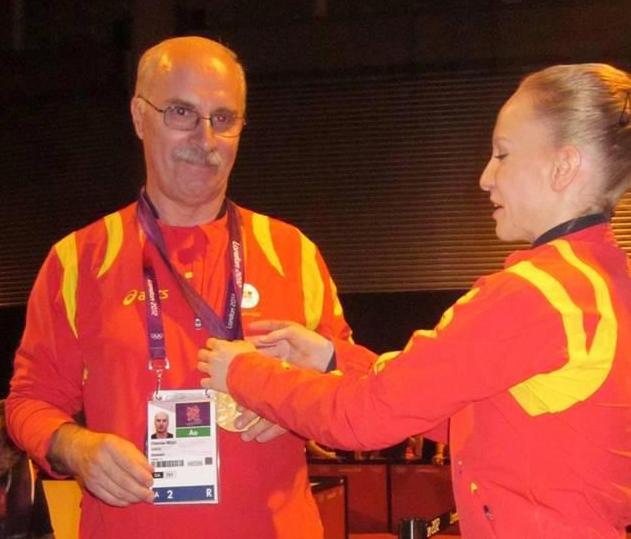
I was really touched by this photograph, which I publish here with thanks to Simona Colesan on Facebook:

Sandra's touching gesture .... "It is as well your medal Mr. Bellu. Thank you ! "
It was the moment when couch Bellu 's eyes went into tears. For couple of seconds he was spechless. "It's for the first time I'm living such a moment. No other gymnast did such a gesture. I have no words... " Bellu replied .

The exuberant Denis Ablyazin won the Russian men's first medal at these Olympics, a bronze on the floor exercise.  Apart from a low landing on his first tumble Denis managed to finish his ultra difficult floor exercise with good execution, and he was clearly delighted with the result. 

China's Zou Kai won gold, Japan's Kohei Uchimura silver, in what is sadly his only final at these Games.  In a competition of execution, Uchimura would have finished first by far ...


Pommel horse was, as predicted, a close fight between the genius Krisztian Berki and flamboyant Louis Smith.  In the end, the marks awarded were a tie, and Krisztian won thanks to his higher execution score.  It was an opportunity to listen to Hungary's atmospheric national anthem.  Britain were delighted when youngster Max Whitlock also took a bronze. 

I can remember a time when, sitting in a gymnastics arena, I was asked by a Canadian onlooker (with a very lovely accent) "'Ooo is zat labouring on ze pommel 'orse?".  It was a British gymnast.  How things have changed.


Make It Or Break It Cheerleaders and the Lost Art of Gymnastics

This has, so far, been the most political Olympic gymnastics competition that I have witnessed in more than 40 years of following the Games.  Some are characterising this as the FIG having chosen in favour of difficulty over execution.  I tend to think of it as something less strategic, more contrived and more misled.  It is almost as though a teen generation of gymnastics judges, let me call them the Make It Or Break It Cheerleaders, have taken over.  Belligerence and venom have been mistaken for reason.  A legion of teenage experts lead the opinion of professional adults who should know significantly better.  The desire for measurement and assumed objectivity - the desire to satisfy the needs of those 'stattos' amongst us who want to be able to predict and justify scores - has led the sport to degrade to the lowest common denominator.  If you don't believe me, just watch the floor final on Sunday - I'll eat my hat if the best wins (it's a felt beret, and will most probably choke me to death).

The most telling statement I have heard so far has come independently from several different sources - 'now that Louis Smith has only managed a silver on pommels, you can be sure that Beth Tweddle will win gold in Monday afternoon's uneven bars final'.  I've no desire to be uncharitable towards Beth - she is a great bars worker and has developed her routine to include an incredible array of difficulty that may well deserve gold - but whatever happened to the idea of the best routine winning?  It's come to something when lifelong fans of the sport have become so hardened and cynical by the political games played by judges that these kinds of opinions can be formed.  It is hard on Tweddle, who may well deserve the gold this afternoon without implications of it as some sort of favour to the hosts.

I have closed a couple of the comments threads on this blog, partly because the argument has become circular, but also because it is simply unpleasant to read some of the personal contumely that is dressed up as argument.  Opinion is necessarily varied around many of the subjects on which I write.  Some of the articles are provocative.  I appreciate reading a variety of opinion, but I don't appreciate it when words like 'moron' appear on my blog, and when discussions of racism replace those of artistry.  The 'trolls' who cause this trouble are in a minority but their behaviour is upsetting to the majority who just want to have an interesting discussion.  I thank the majority for their contributions, and hope they will continue to come here and to comment.

There are terrible double standards: elsewhere, the behaviour of McKayla Maroney on the podium goes unquestioned, while every sorrowful tear of Viktoria Komova is criticised as 'unsporting'.  I just think they are both teenagers, leave them alone.  It's highly unfashionable to bemoan Maroney's silver medal on vault, with a fall, yet every stutter and fall from a Russian labels the athlete a 'headcase'.  It is the kind of talk you might expect from a group of particularly poisonous 12 and 13 year olds desperate for a place in the most popular clique at school, multiplied by the power of the internet which, quite unselectively, gives voice to those with the most malice and greatest talent for insult.  I wonder if they would be so outspoken in person?  But the media, the coaches, the gymnasts, begin to follow suit : International Gymnast comments on an apparent slight by bronze medallist Aliya Mustafina of her coach; coach John Geddert blogs about the unfairness of the 2 per country rule which saw his gymnast Jordyn Wieber ruled out of all around finals; 16 year old German, Janine Berger, puts herself through the ordeal of a tearful press statement announcing her disappointment at finishing fourth on vault. 
 
Despite all of this fearsome noise, judges have to take responsibility for their judging at this competition.  I've heard it said, in defence of the judges, that the Code ties their hands.  While there are deductions specified for particular errors such as steps on landing, superior body posture and leg line do not attract a bonus.  This argument blames the Code whilst characterising the judges as powerless robots with no initiative, no imagination, and no moral dimension to their work.  But the Code does give a choice of whether to make the deduction at all, or whether to give a lower level of deduction.  The judges do have a choice of how to implement the Code, but many of them seem pretty clueless.  Russian coach Marina Nazarova has pointed out how inexperienced judges were unable to adjust to Ksenia Semenova's improvements over the course of the 2008 Beijing Olympics.

An understanding of ballet training as a requirement to good gymnastic basics is lacking by many who mistake it as a personal preference for classical dance in the choreography of floor and beam routines.  Most American gyms do not employ a full time choreographer to hone and polish the work of their gymnasts from an early age, before bad habits can become engrained.  The culling of compulsory exercises many years ago has left the judges without a baseline by which to judge basic skills, allowing terrible unsightly gymnastics to dominate even at the top of the sport.  One well qualified commentator has observed that the tie-break procedure ... where execution scores determine the finishing order if the overall score is identical - is the only time that the sport prefers execution over difficulty.

The women's sport is groaning under the overwhelming influence of poor judgement and media distortion.   Russia made significant errors in the team competition and America deserved their gold there.  Judges made a poor call of the all around medallists.   The unexplained reduction in marking differential between USA and Russia on the bars has been instrumental in seeing America take gold in both the team and all around competitions here in London.  Russia's balletic heritage is apparently counting for nothing in a battle with a legion of MIOBI Cheerleaders. 

On Sunday, we will see the finals of the beam and floor exercises, the blue riband events of any gymnastics competition.  In both finals, 20 year old Ksenia Afanasyeva has qualified, her beautifully performed exercises a reminder of the gymnastics of the past.  Yet her start values do not measure up to the competition and her chances of winning either event - even if she avoids error - are low, if not non existent.  If Afansyeva were injured, she could be replaced in the beam final by compatriot Anastasia Grishina, a gymnast of almost equal beauty, without the experience of Afanasyeva but with a potentially higher start value and, therefore, a stab at a medal.  This would rob the floor final of Afanasyeva's amazing grace, most likely leaving a line up of Who Dares Wins cheerleaders (Raisman, Ferrari, Wieber) with the medals.  The FIG will have the sport it wants.

Before the competition began, team captain Ksenia Afanasyeva stated : 'We will win with beauty'.  Russia are the only team wholeheartedly to embrace this vision and philosophy.  In the dark room that is women's artistic gymnastics, the Russian team sits in a beacon of fading light.  How much longer can they prevail?

Saturday, August 4, 2012

Can Maroney score the ten? Considering tomorrow's apparatus finals

These are the Olympics and - for some reason, perhaps television schedules, maybe ticket revenues - the organisers have split our apparatus finals over three days rather than the usual two.  There has also been a two day break since the team and all around competitions.  This means that some of the gymnasts qualified for finals will have to stay fresh, alert and competitive till next Tuesday.  It is the longest Olympic gymnastics competition I have experienced in 40 years or so of following the sport.  And it certainly made it prohibitively expensive for all but the most loyal corporate follower to attend every day at the gymnastics this year.

The Olympic organisers will also have to learn if this format works for the competitors.  No doubt some gymnasts will thrive on the rest they have been allowed ... then maybe, there is the risk that some may provide stunningly off focus exercises. 

We do not yet have start lists for tomorrow's competitions, but I do have details of the gymnasts qualified to finals ... first of all, men's floor ...


I'm going to stick my neck out and tell you to watch Ablyazin in this final.  His big problem will be fitting all that difficulty into the all too short 1 minute 30 second time frame allowed for the exercise, and staying inside the floor area.  If he can do both, his score may well zip up and take the competition by surprise.  The legendary Uchimura is also on the rise after a difficult qualifying round, and Zou Kai cannot be counted out - he tends to lack a little finesse on the floor, but his difficulty level always makes him a threat for gold.

Women's Vault

In this final the gymnasts have to demonstrate two vaults; the winner will be the one who manages to demonstrate the highest difficulty with the least error.  Precious few gymnasts practice two vaults at all these days, meaning that the apparatus has become the domain of specialists.  Of the top four gymnasts, only one, Iszbasa, competed in the all around.

Vault is also controversial.  Some consider the Amanar vault to be scored too highly (6.5 start value) relative to its nearest equivalent (for example, a double twisting Yurchenko is worth 5.8), giving those who perform it a disproportionate advantage in all around and team finals.  For the uninitiated, an Amanar is a  vault with half a twist onto the horse and two and a half twists off, all combined with somersaulting actions on and off.

But in the apparatus finals, the scoring of the Amanar could provide some real excitement.  The question is, can America's McKayla Maroney score a historic ten in execution tomorrow?  The first ten ever, under the new, open ended Code of Points.   Her vault is high, strong and beautiful.  Some would argue that vault lacks the complexity of other apparatus to force error, but generating and controlling all that flight is a fearsome achievement.  Maroney is the strong favourite for gold barring major disaster.

Elsewhere, human interest is provided by the qualification of gymnastic geriatric Oksana Chusovitina, at 37 the oldest female artistic gymnast in the competition.  Oksana was a first time Olympian competing for the Soviet Union in the 1992 Olympics when she won the gold medal on the floor.  She now has a family, and competes for her adopted country, Germany.  She will contend strongly for a medal here.  Her nearest rival could be Maria Paseka, whom the Russians brought to London purely for her vaulting ability.

Beyond the top two, this final lacks a bit of strength in depth, so expect surprises especially if there are errors. Vault is over in the flash of an eye!

Pommel horse


Louis Smith is renowned for his difficulty, but his execution at this competition has also improved significantly - having given his all for team and qualifying, can the bad boy of British gymnastics hold it together a third time?  Competing for gold alongside him will be the immaculate Krisztian Berki.  Berki of Hungary, inheritor of his country's long legacy of pommel horse specialists, had a poor qualifying round but still managed to finish in fifth.  If Berki is on song he could deprive Louis Smith of gold, even if Smith is at his best - talent will out, dears.